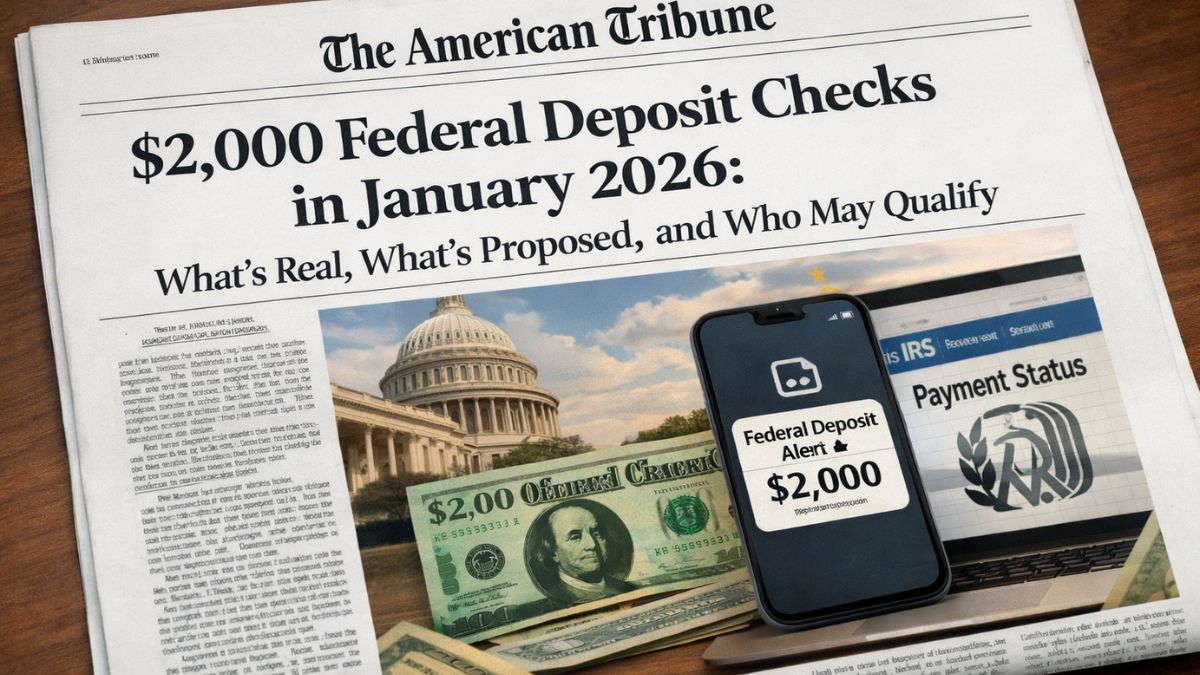
$2000 Federal Deposit Checks – As January 2026 gets underway, a lot of Americans are keeping a close eye on their bank accounts. Online searches and social media posts about “$2,000 federal deposit checks” have spiked, with claims ranging from hopeful to outright misleading. For families still feeling squeezed by high grocery prices, rent, and everyday expenses, the idea of a $2,000 direct payment understandably sounds appealing.
But despite all the chatter, it’s important to separate what’s actually happening from what’s only being discussed. Right now, there is no confirmed $2,000 federal deposit program. What exists instead is a proposal that has sparked debate, confusion, and plenty of speculation.
Where the $2,000 Federal Deposit Idea Came From
The idea behind the $2,000 federal deposit checks didn’t come from an official government rollout or an emergency relief program. Instead, it originated as a political proposal tied to tariff revenue. Supporters of the idea argue that money collected from tariffs on imported goods could be returned directly to Americans as a kind of economic dividend.

The pitch is simple: if tariffs generate revenue, some of that money could go straight back into the pockets of U.S. households to help offset rising living costs. While the concept has gained attention online, it’s very different from past stimulus checks that were quickly approved during the pandemic.
Unlike those earlier payments, this proposal has not been passed into law. Without Congressional approval, federal agencies like the IRS and the U.S. Treasury have no authority to send out checks or deposits tied to this idea.
The Current Reality in January 2026
As of late January 2026, there are no approved $2,000 federal deposit checks. No payments have been scheduled, and no official announcements have been made by the Treasury Department or the IRS. There is no confirmed timeline, no eligibility rules, and no application process because the program simply does not exist yet.

Budget experts also point out that tariff revenue is already used to support a variety of federal obligations. Redirecting that money into direct payments would require new legislation, detailed funding plans, and clear rules on who qualifies. None of that has happened so far.
If a real program were approved, it would be widely announced through official government channels. Right now, the absence of formal guidance is a strong signal that the payments remain hypothetical.
Why Approval and Funding Are Major Hurdles
One of the biggest challenges facing this proposal is cost. Sending $2,000 to a large portion of the U.S. population would require hundreds of billions of dollars. Even in strong trade years, tariff revenue alone may not be enough to fund such a massive payout without cutting other programs or increasing the federal deficit.

There’s also legal uncertainty. Tariffs have faced court challenges in recent years, and changes in trade policy could reduce how much revenue is actually available. That makes it difficult to rely on tariffs as a stable funding source for ongoing or large-scale payments.
Because of these factors, economists and policymakers agree that nationwide payments would be difficult to approve quickly, especially without broad political support.
Who Might Qualify If Payments Ever Happen
Since no legislation has been passed, there are no official eligibility rules. Still, discussions around the proposal suggest that any future payments would likely be targeted rather than universal.
Middle- and lower-income households are often mentioned as the most likely beneficiaries, while higher earners could be excluded or phased out. If lawmakers were to move forward, eligibility would probably be based on adjusted gross income using recent tax returns, similar to previous federal relief programs.
Direct deposit information already on file with the IRS would likely be used to distribute payments efficiently, but again, this would only happen after formal approval.
Why So Many People Are Confused
Much of the confusion comes from timing. Early tax refunds, Social Security payments, and cost-of-living adjustments are all continuing as normal in 2026. Some people have mistaken these routine deposits for the rumored $2,000 payments, especially when the amounts are larger than expected.

Social media has also played a role in spreading misinformation. Posts claiming that deposits are “already happening” or that people need to “claim” their money are not based on official sources. Federal agencies have made it clear that any new stimulus-style payment would be announced publicly and directly.
If you see messages asking for fees, personal information, or urgent action to release a payment, those are almost certainly scams.
Looking Back at Past Federal Payments
The pandemic stimulus checks of 2020 and 2021 set expectations high. Once Congress approved those payments, money reached millions of Americans quickly because the systems were already in place and the situation was considered an emergency.

However, those payments were funded differently and backed by clear legislation. The current proposal does not have the same urgency or legal framework. While past experiences show that the government can move fast when needed, that doesn’t mean every proposal will turn into a check.
What a $2,000 Payment Could Mean for the Economy
If $2,000 federal deposits were ever approved, the economic impact would be noticeable. Supporters believe the money would help families pay down debt, cover essential expenses, and boost consumer spending, which could benefit small businesses.
Critics worry that large cash payments could add to inflation, especially in areas like housing, services, and everyday goods. Lawmakers would have to weigh short-term relief against long-term economic stability, a debate that continues to divide experts.

What You Should Do Right Now
For now, the best approach is caution. Households should not plan their budgets around unapproved federal payments. If something eventually happens, it should be treated as extra help, not guaranteed income.
Practical steps include filing your 2025 tax return on time, keeping your direct deposit information current with the IRS, and staying informed through official government announcements. Most importantly, be wary of scams. No legitimate federal program charges fees or requires advance payments to release money.
The Bottom Line
Despite widespread headlines and online buzz, $2,000 federal deposit checks for January 2026 are still just a proposal. Nothing has been approved, no payments have been issued, and no eligibility rules have been finalized. Until actual legislation is passed, Americans should rely on verified government sources rather than speculation.

Staying informed, patient, and financially cautious remains the smartest move in a landscape full of rumors but few confirmed facts.
Disclaimer
This article is intended for informational purposes only and should not be considered financial, tax, or legal advice. Federal payment programs, eligibility requirements, and timelines depend on legislative approval and may change at any time. Readers are encouraged to consult official government sources or qualified financial and tax professionals for guidance specific to their personal situation.