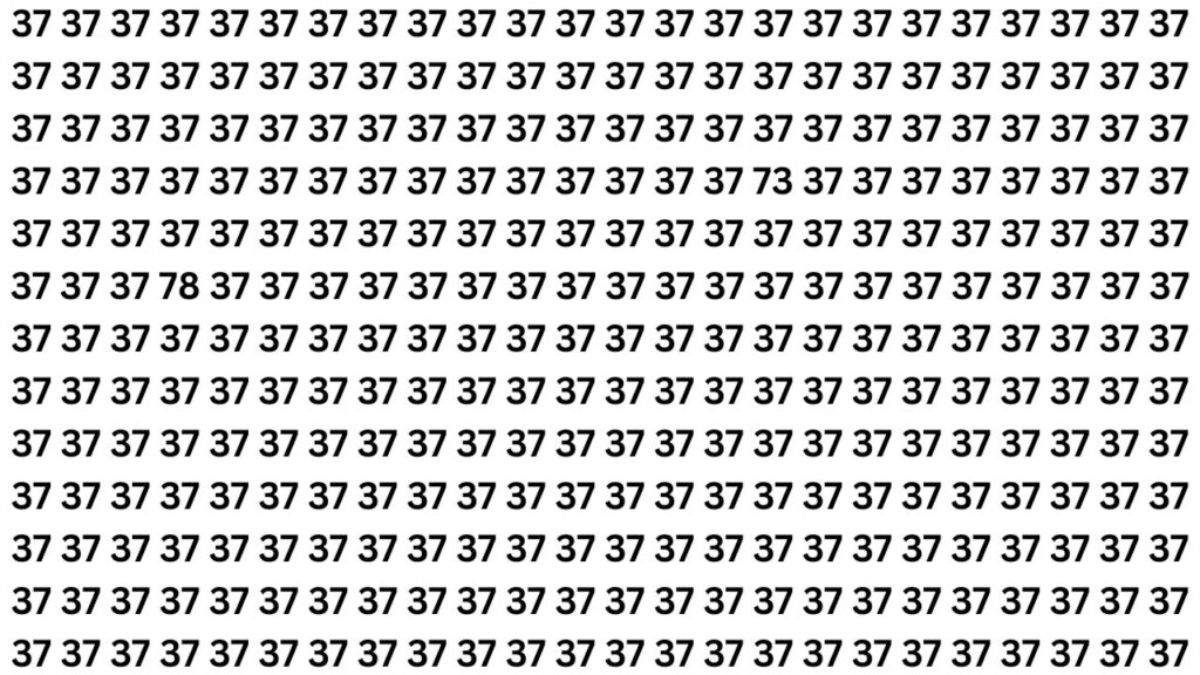
Spot the Hidden 78 in 10 Seconds – Optical illusion challenges have become a favourite way to test attention and focus online, and this one is deceptively tricky. At first glance, the image looks like nothing more than rows of repeated numbers. But hidden somewhere among the 73s and 37s is a single number 78 — and you have just 10 seconds to find it. Most people underestimate how hard this is until the clock starts ticking.
The puzzle works because your brain loves shortcuts. When it sees the same numbers repeated again and again, it quickly assumes everything is identical. That mental shortcut saves time in everyday life, but in visual challenges like this one, it can cause you to miss what’s right in front of you.
Why This Number Puzzle Feels So Difficult
The main reason this illusion is challenging is visual similarity. The numbers 73, 37, and 78 share similar shapes and lines, especially when placed close together in a grid. Once your brain locks onto the repeating pattern of 73 and 37, it stops checking each number carefully.
यह भी पढ़े:
 Extra Cash for Young Australians: Youth Allowance Increase of $1,011.50 + $16.20 from Jan 2026
Repetition also plays a role. When the same elements appear over and over, your eyes start scanning instead of reading. Instead of processing each number digit by digit, your brain assumes the next one will be the same as the last. That is exactly how the hidden 78 blends in so effectively.
How the 10-Second Time Limit Tricks Your Brain
Ten seconds may sound generous, but under pressure it disappears very quickly. As soon as you know you are being timed, your brain switches into speed mode. Rather than analysing each number carefully, your eyes move faster, hoping the odd one will stand out naturally.
This illusion takes advantage of that behaviour. The difference between 78 and the surrounding numbers is subtle, not dramatic. Because nothing jumps out immediately, the brain keeps skimming, often running out of time before the detail is properly processed.

Smart Ways to Find the Hidden 78 Faster
Random scanning rarely works with puzzles like this. A better approach is to scan systematically, either row by row or column by column, just like reading text. This forces your brain to slow down slightly and actually check what it is seeing.
Another helpful trick is to focus on a single digit rather than the full number. Instead of reading “73” or “37,” look specifically for where the 7 sits or how the second digit curves. The number 8 has a unique shape compared to 3, and training your eyes to spot that difference makes the odd number easier to detect.
Staying calm also matters. Rushing increases the chance that your brain will rely on assumptions instead of observation.
यह भी पढ़े:
 Centrelink Confirms a $1178 Annual Pension Boost for Age Pensioners Starting 25 January 2026
What Spotting 78 Quickly Says About You
If you found the 78 within the time limit, it suggests strong visual attention and good focus under pressure. People who enjoy puzzles, reading, design work, or problem-solving often perform well in these challenges because they are used to noticing small details.
If it took longer, that does not mean you lack ability. It usually means your brain prioritises efficiency over precision, which is useful in many real-world situations. These illusions are designed to mislead, so missing the answer is very common.
Why Optical Illusions Like This Are So Popular
Number-based optical illusions are easy to understand and quick to attempt, which makes them perfect for online sharing. There are no complicated rules, and anyone can join in instantly. That simplicity, combined with the challenge, makes them addictive.
They also offer instant feedback. You either find the hidden number or you don’t, which keeps people engaged and encourages repeat attempts. Over time, regularly doing puzzles like this can improve attention, patience, and visual awareness.
Try Again With a Fresh Perspective
If you missed the 78 on your first attempt, take a short break and try again. Many people succeed on the second try because their brain is no longer fooled by the initial pattern. Once you know the trick, the illusion loses some of its power.
Puzzles like this are a reminder that seeing is not the same as observing. Slowing down just a little can reveal details that were invisible moments earlier.

Final Thoughts
Finding the number 78 hidden among rows of 73 and 37 may seem like a small challenge, but it highlights how easily the brain can be tricked by repetition and expectation. Whether you solved it quickly or needed a second look, the puzzle shows how attention, timing, and perception work together. With practice, your eyes and brain can learn to spot these differences faster — even under pressure.
Disclaimer
This article is provided for general informational and entertainment purposes only. Optical illusion challenges are designed to test visual attention and pattern recognition and are not a scientific measure of intelligence or cognitive ability. Individual performance may vary based on factors such as focus, screen size, lighting, and fatigue. The content should not be interpreted as medical, psychological, or educational advice. Always consult qualified professionals for assessments related to cognitive health or vision concerns.