
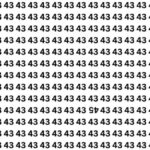
Find the Inverted 765 Among 765 – If you think spotting numbers is easy, think again. This little optical illusion challenge looks simple on paper but quickly proves it’s not. The task is to find an inverted 765 hidden among rows of regular 765s, all within just eight seconds. At first glance, every number seems identical—same size, same alignment, same digits. That repetition is exactly what tricks your brain into assuming everything is the same.
The challenge isn’t just about eyesight—it’s about focus and how well your brain handles visual information under pressure. Numbers, when repeated, become almost invisible to the mind because the brain loves patterns. It automatically groups things together and stops scrutinising each detail carefully. That’s why the inverted 765 is so sneaky. It only breaks the pattern slightly, with a subtle flip or rotation that your eyes might miss if you’re scanning too fast.
Why the Inverted 765 Is So Tricky
Humans are wired to read numbers as whole units rather than separate digits. Your brain reads “765” as a single block instead of focusing on the 7, 6, and 5 individually. That makes spotting any minor changes much harder, especially under time pressure. When you’re rushing, even the most obvious differences can go unnoticed.
यह भी पढ़े:
 Extra Cash for Young Australians: Youth Allowance Increase of $1,011.50 + $16.20 from Jan 2026
This illusion works because it exploits natural habits. You’re used to scanning numbers from left to right, so any small anomaly outside that pattern tends to blend in. The inverted 765 sticks out only if you slow down, pay attention to shapes, and stop reading the numbers as familiar values.
How to Spot the Inverted 765 Faster
There are a few tricks to improving your chances. First, forget the numbers themselves. Treat them more like symbols. Focus on angles, curves, and spacing rather than what the digits actually mean. By paying attention to visual structure instead of numerical meaning, the odd one out becomes easier to notice.
Another strategy is to scan in a different direction. Instead of moving left to right, try looking vertically or diagonally. Changing the direction of your scan breaks your natural reading habit and helps your eyes catch any visual inconsistencies.
यह भी पढ़े:
 Centrelink Confirms a $1178 Annual Pension Boost for Age Pensioners Starting 25 January 2026
Finally, stay calm. Rushing makes it easy to miss the inverted 765 because your brain jumps to conclusions too quickly. Taking a moment to slow your gaze and carefully examine the numbers can make the hidden digit appear almost instantly.
What This Challenge Says About You
If you manage to spot the inverted 765 in just eight seconds, it suggests you have strong visual focus and can disrupt patterns effectively. These skills are useful in everyday tasks like proofreading, data checking, design work, and problem-solving.
However, missing the inverted 765 doesn’t mean your eyesight is poor or that you lack intelligence. Optical illusions are designed to fool everyone, even those with perfect vision. They rely on how the brain processes familiar patterns, not on whether you can see clearly.
Final Thoughts
These optical illusion challenges are more than just fun—they’re a reminder that seeing is about attention and patience as much as it is about eyesight. If you didn’t find the inverted 765 in time, give it another go without the timer. Allow your eyes to adjust and scan carefully, and you might be surprised at how quickly the hidden number appears.
Share this challenge with friends and see who spots it first. Not only is it a fun game, but it also gives a subtle insight into how our brains can be tricked by patterns we take for granted. Next time you look at a repeated sequence, remember: your brain might be seeing more than you realise—or it might be missing something right in front of your eyes.
Disclaimer

This post is intended for entertainment and general cognitive exercise purposes only. The optical illusion described here is not a vision test and should not be relied upon to assess eyesight or cognitive ability. Everyone experiences visual perception differently, and missing the inverted number does not indicate poor vision or low intelligence. Always consult a qualified professional for any medical or vision-related concerns.
