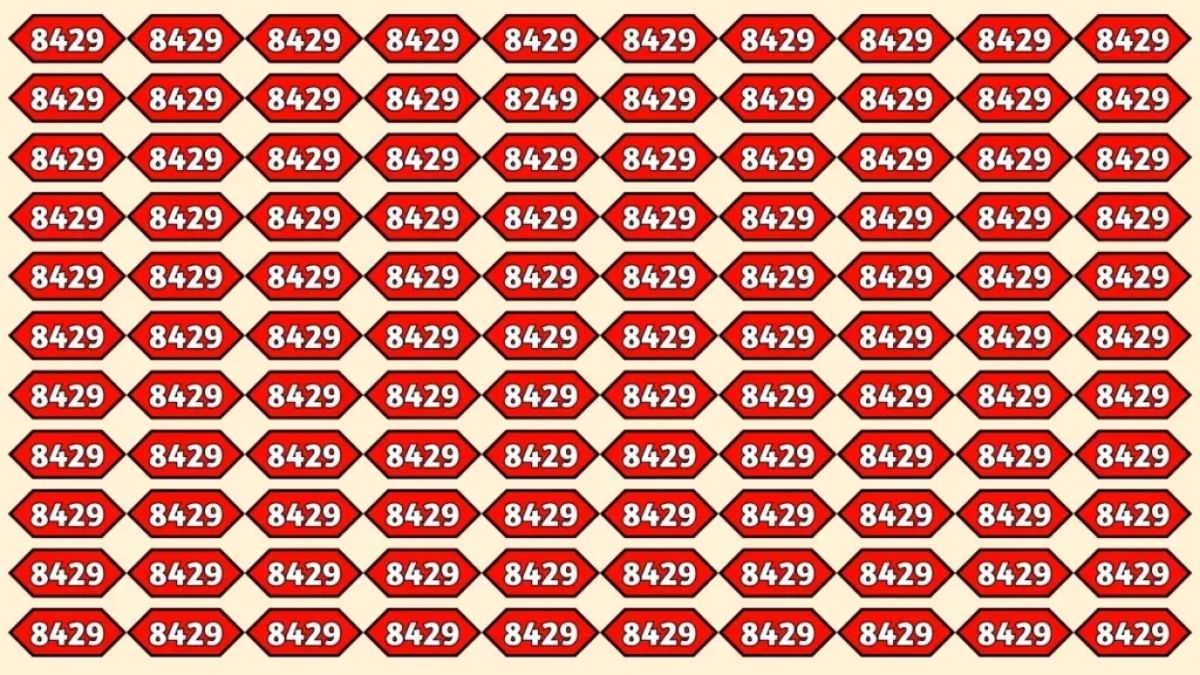
Find 8249 Among 8429s – If you enjoy giving your brain a little workout, this optical illusion is right up your alley. On first glance, it looks like a simple grid of numbers, all the same—just rows and rows of 8429. But hidden somewhere in the jumble is a sneaky twist: one number is different. It’s 8249. Spotting it quickly is where the real challenge lies.
These kinds of number-based visual puzzles are popular because they push your brain to focus in ways everyday life usually doesn’t. Our eyes are excellent at taking in loads of information, but our brains love patterns. Once the brain locks onto a familiar sequence, it can stop paying attention to small details. That’s exactly what makes finding 8249 tricky. The digits are all the same, just rearranged, so your brain can easily assume everything matches and move on without noticing.
Many people try to complete this challenge in under 10 seconds. Some spot the odd number almost instantly, while others stare at the numbers for ages and still can’t see the difference. There’s no shame in either outcome—the point isn’t to compete but to exercise your attention to detail and mental focus.
यह भी पढ़े:
 Extra Cash for Young Australians: Youth Allowance Increase of $1,011.50 + $16.20 from Jan 2026
Why This Optical Illusion Feels So Tricky
The main challenge comes from the numbers themselves. Both versions use the same digits—8, 4, 2, and 9—but the order is different. Because of this, your brain assumes it’s seeing the same pattern repeatedly. This mental shortcut is useful in daily life; it helps us process information faster and save energy. But in a puzzle like this, it works against us, making it easy to miss the subtle difference.
Another reason it’s tough is scanning fatigue. When numbers repeat in rows, our eyes naturally start skimming rather than reading each digit carefully. Even if the odd number is right in front of you, your brain can convince itself everything is identical, and you move on without noticing the disruption. The repeated patterns are essentially tricking your own focus.
Tips for Spotting 8249 Faster
If you want to improve your chances of spotting the odd number quickly, there are a few tricks you can use. One effective method is to focus on just one digit at a time rather than reading the whole number. For example, you might scan for where the ‘2’ or ‘4’ is placed differently. Once you notice something slightly off, narrow your attention to that area and check carefully.

Another helpful technique is to scan the numbers vertically instead of the usual horizontal rows. This interrupts the repetitive pattern and forces your brain to reprocess the numbers in a new way. Staying calm also makes a big difference. When you rush, your eyes move faster than your brain can analyse what they see, making it more likely you’ll miss the odd number. A steady, methodical scan usually works better than frantically darting your eyes across the page.
What This Challenge Reveals About Your Brain
If you spotted 8249 quickly, it doesn’t necessarily mean you’re smarter than anyone else. It just shows that you noticed a small disruption in a pattern that most people might miss at first glance. People who enjoy puzzles, reading, or detail-oriented tasks often find these challenges easier because their brains are trained to pay attention to small differences.
If it took you longer, that’s perfectly normal too. Your brain might prioritise speed over accuracy, which is actually quite useful in everyday life. We often need to process information quickly without getting stuck on minor details. These puzzles are less about intelligence and more about how your brain balances speed, accuracy, and attention.
यह भी पढ़े:
 Centrelink Confirms a $1178 Annual Pension Boost for Age Pensioners Starting 25 January 2026
The fun of these optical illusions lies in how they reveal the way our brains work. They are a reminder that perception isn’t always reality. Something as simple as a row of numbers can trick our mind into seeing patterns that aren’t really there. These exercises don’t just test focus—they also improve it over time. Practising small observation challenges like this can help you become more detail-oriented and sharper in everyday situations, whether it’s reading fine print, spotting errors, or noticing subtle changes around you.
Number-based optical illusions are a simple yet powerful way to exercise your brain. They combine visual processing, pattern recognition, and attention to detail into one engaging challenge. The next time you see a puzzle like this, try applying these techniques: focus on one digit, scan vertically, and stay calm. You might surprise yourself with how quickly you can spot the odd one out. And even if you don’t, you’ve still given your brain a valuable workout.
In a world full of distractions, exercises like this remind us to slow down and really pay attention. They show how small differences matter, and how even a tiny disruption in a pattern can test our observation skills. So whether you’re a puzzle enthusiast or just looking for a quick mental challenge, spotting 8249 among the 8429s is a fun way to keep your mind sharp.

Disclaimer
This post is for entertainment and brain-training purposes only. It does not provide medical or professional advice, and the results of optical illusions or puzzles may vary from person to person. Performance in these challenges does not reflect intelligence, cognitive ability, or attention span in real-life situations. Readers should enjoy these exercises as a fun way to test focus and observation skills, without placing undue pressure on themselves to perform within a specific time frame.