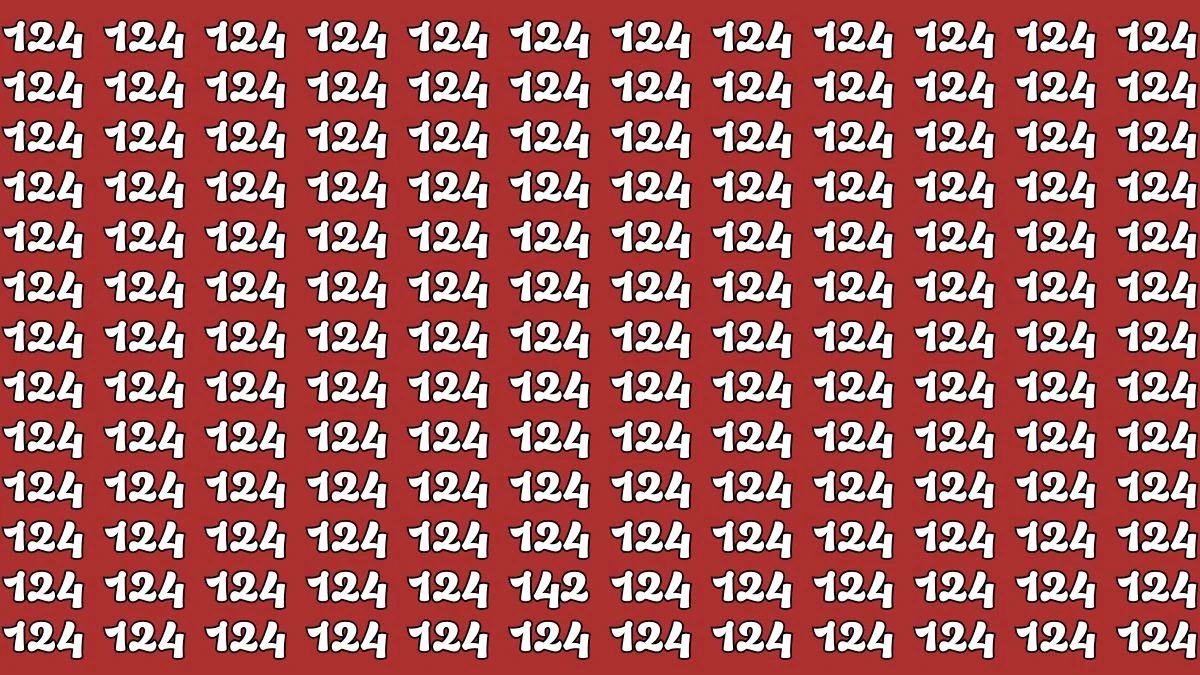
Spot 142 Among Identical 124s In Just 9 Seconds – At first glance, every number in this visual challenge looks exactly the same. Rows and rows of 124 repeat across the image, forming a neat pattern that quickly feels familiar. But hidden somewhere in this grid is the number 142. Your task is simple, yet surprisingly tricky. Can you find the odd number out in just 9 seconds before time runs out?
These observation challenges test how well your eyes and brain work together under pressure. The similarity between 124 and 142 is what makes this puzzle so effective. Many people rush and miss it completely, while others slow down slightly and spot it just in time.
Why This Illusion Is So Tricky
This illusion works because of repetition. When the same number appears again and again, your brain groups them together and stops analysing each one carefully. Instead of reading every digit, your mind assumes they are all the same. That assumption allows 142 to hide in plain sight.
यह भी पढ़े:
 Extra Cash for Young Australians: Youth Allowance Increase of $1,011.50 + $16.20 from Jan 2026
Another reason this puzzle is difficult is digit familiarity. Both numbers use the same digits — 1, 2, and 4 — just arranged differently. Your eyes may recognise the digits but fail to notice the order has changed. That small switch is enough to fool even sharp observers.
The 9-second time limit adds extra pressure. When people feel rushed, they tend to scan randomly, which increases the chance of missing small differences. Staying calm actually improves your odds.
How To Improve Your Chances Of Spotting 142
A helpful trick is to stop reading the number as a whole and instead focus on individual digits. Look closely at the middle digit first. In 124, the middle digit is always 2, but in 142 it appears in a different position. This small shift can make the hidden number stand out faster.

Scanning the image in a structured way also helps. Move row by row or column by column instead of letting your eyes jump around. This reduces confusion and keeps your focus steady.
If you feel stuck, blink once or briefly look away, then return to the image. That short reset often helps your brain notice details it missed moments earlier.
What This Challenge Reveals About Your Brain
If you spotted 142 within the time limit, it suggests strong visual discrimination skills. Your brain can quickly detect subtle differences even when patterns try to distract you. This ability is useful in everyday situations, from proofreading text to spotting changes in your surroundings.
यह भी पढ़े:
 Centrelink Confirms a $1178 Annual Pension Boost for Age Pensioners Starting 25 January 2026
If it took longer, that is completely normal. These puzzles are designed to trick everyone. With practice, your brain learns how to slow down automatic assumptions and focus on detail. Many people notice improvement after just a few similar challenges.
Either way, puzzles like this are a fun way to sharpen focus, patience, and attention to detail without any pressure.
Ready For The Answer?
Before reading further, take one last look at the image. Scan carefully and check the order of the digits rather than the digits themselves. The hidden 142 is often placed where your eyes least expect it, sometimes near the centre or blended into a dense part of the grid.
Once you finally see it, you may be surprised at how obvious it suddenly looks. That moment of realisation is exactly why optical illusions are so satisfying.
Frequently Asked Questions
Many people ask what exactly an optical illusion challenge is. It is a visual puzzle designed to trick the brain into misinterpreting what the eyes see, usually through repetition, patterns, or subtle differences. Number-based illusions feel especially difficult because the brain recognises patterns faster than details. Spotting 142 quickly reflects good focus and visual processing speed, but it does not measure intelligence. Anyone can improve with practice and calm scanning.
Final Thoughts
Finding 142 among a grid of identical 124s may seem like a small task, but it reveals a lot about how perception works. Whether you spotted it instantly or struggled to see it at all, the experience shows how easily the brain can be misled by patterns. Keep trying challenges like this, and you may notice your observation skills becoming sharper over time.

Disclaimer
This article is provided for general entertainment and informational purposes only. Visual and number-based illusion challenges are designed to test perception and attention and do not measure intelligence, eyesight, or cognitive ability. Results may vary depending on focus, screen size, and viewing conditions. This content does not provide medical, psychological, or professional advice and should not be used as a diagnostic or assessment tool.