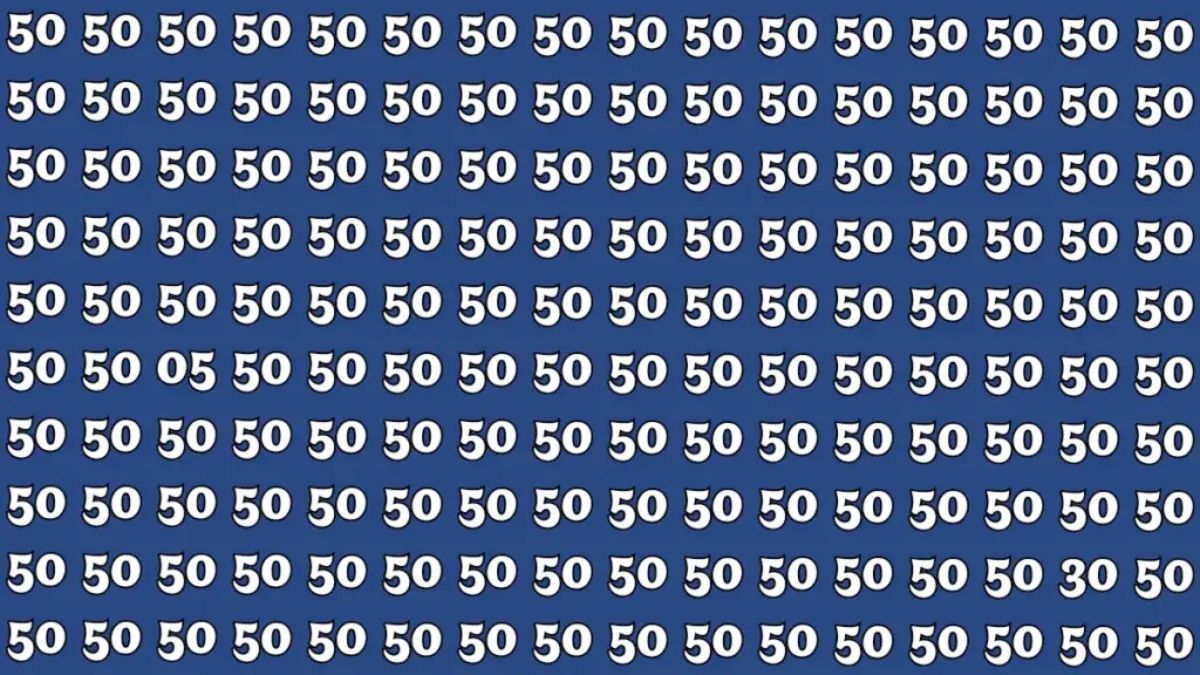
Find 05 and 30 Among 50s – Fast visual puzzles have a way of grabbing attention straight away. At first glance, everything looks easy. The same number repeats over and over, making your brain feel comfortable and confident. Then comes the challenge. Hidden somewhere among all those 50s are the numbers 05 and 30, and you only have five seconds to find them. This puzzle isn’t about maths or logic. It’s about speed, focus, and how well your eyes and brain work together when the pressure is on.
Why This Challenge Feels Harder Than It Looks
The main reason this puzzle feels tricky is visual similarity. The numbers 50, 05, and 30 share curved shapes and similar lines, especially when viewed quickly. When your brain sees the same pattern repeated many times, it switches to autopilot mode. Instead of carefully checking each number, it assumes they’re all the same. This is known as visual adaptation, where details are filtered out because the brain thinks nothing has changed.
Time pressure makes it even harder. Five seconds sounds manageable, but once the countdown starts, stress kicks in. Your eyes begin jumping randomly instead of scanning calmly, which makes it easy to miss small differences even when they’re right in front of you.
यह भी पढ़े:
 Extra Cash for Young Australians: Youth Allowance Increase of $1,011.50 + $16.20 from Jan 2026
How to Approach the Puzzle More Smartly
A better approach is to stop reading the numbers and start looking at shapes. Focus on curves and gaps instead of digits. The number 30 has a more open curve at the top that doesn’t match the shape of 50, and 05 often looks slightly reversed or out of place compared to the repeating pattern. Training your eyes to spot shape differences instead of full numbers can make a big difference.
Scanning in straight lines also helps. Move left to right or top to bottom without skipping areas. This creates rhythm and reduces panic scanning. Some people find that relaxing their eyes or slightly squinting helps the odd numbers stand out more clearly.
What Your Result Says About Your Focus
If you manage to spot both 05 and 30 within five seconds, it suggests strong visual discrimination and the ability to filter out background noise quickly. This type of focus is useful in everyday situations that require quick decisions or attention to detail. If you only find one number or miss both, that’s completely normal. These puzzles are designed to trick the brain, and things like fatigue, lighting, and screen size can affect performance.
The real value isn’t whether you succeed on the first try, but how your focus improves with practice. Over time, your brain learns to slow down and observe more carefully.
Why People Love Fast Focus Challenges
Fast focus challenges are popular because they’re quick, exciting, and satisfying. There’s a small rush when you beat the clock and a sense of curiosity when you don’t. Many people enjoy sharing these puzzles with friends or family, turning them into friendly competitions. Comparing results and times adds to the fun and keeps people coming back for more.
Beyond entertainment, these puzzles encourage short bursts of deep focus. In a world full of distractions, even a few minutes of concentrated observation can be a healthy mental break.
यह भी पढ़े:
 Centrelink Confirms a $1178 Annual Pension Boost for Age Pensioners Starting 25 January 2026
Frequently Asked Questions
Many people ask what the goal of this challenge is, and it’s simply to spot the numbers 05 and 30 hidden among repeated 50s within five seconds. It’s very normal to miss one or both numbers on the first attempt, as repetition tricks the brain into rushing. Solving these puzzles doesn’t measure intelligence or IQ. They mainly test attention and visual processing speed. Practising optical illusions regularly can help improve concentration and observation skills over time. Using a timer adds pressure and excitement, but practising without one can help train careful scanning. These puzzles are generally suitable for teens and adults, and younger children may enjoy them too without strict time limits.
Disclaimer
This article is intended for general entertainment and informational purposes only. Visual puzzles and optical illusions are not a scientific measure of intelligence, eyesight, or cognitive ability. Individual results may vary depending on focus level, screen size, lighting, and time pressure. This content should not be used for medical, psychological, or diagnostic purposes. Readers are encouraged to enjoy these challenges purely as a fun way to engage attention and observation skills.